Lead Within: The Art of Changing Systems Without Losing People
HB Weekly Leadership Brief
Week of March 16, 2026
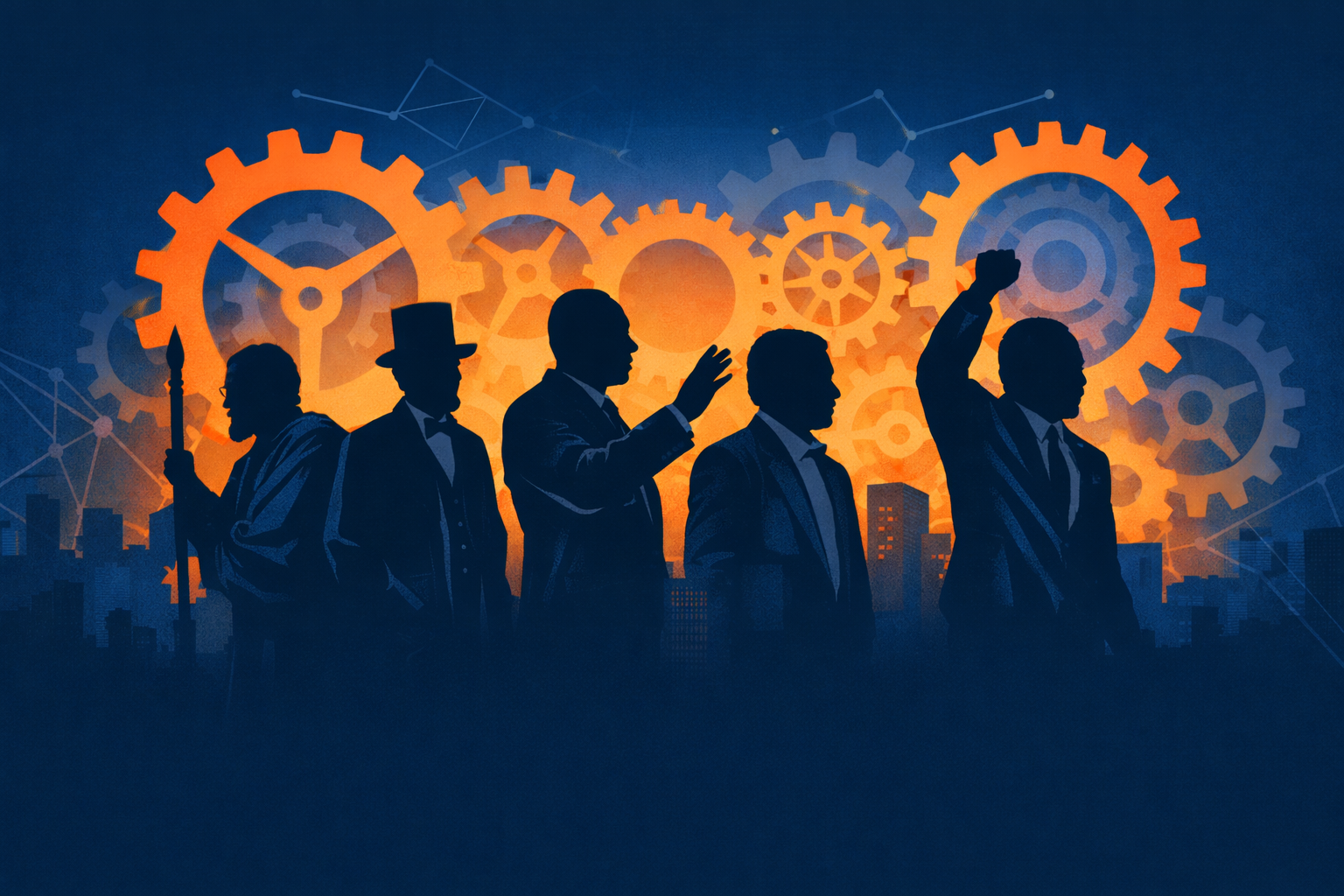
Most leaders eventually face the same tension: Do I spend my energy attacking the system from the outside, or changing it from the inside?
This week’s Brief is about that difficult middle space, the space between idealism and pragmatism. The strongest leaders do not confuse patience with passivity, nor conviction with chaos. They learn the system they are in, understand its pressure points, and steadily move people toward a better future without losing the trust of those still living in the present one.
This is not cowardice. It is not compromise for compromise’s sake. It is disciplined leadership. It is the courage to face reality as it is, while still refusing to give up on the world that could be.
“Human progress is neither automatic nor inevitable... Every step toward the goal of justice requires sacrifice, suffering, and struggle.” — Martin Luther King Jr.
“The credit belongs to the man who is actually in the arena, whose face is marred by dust and sweat and blood...” — Theodore Roosevelt
By The Numbers
Deloitte’s 2026 Global Human Capital Trends suggests that only 27% of respondents say their organizations manage change effectively.
BCG reported in 2024 that only 26% of corporate transformations over the past two decades successfully created value in both the short and long term.
Prosci’s Best Practices in Change Management research identified mid-level managers as the most resistant group to change, with 43% of participants naming them as such.
A Consult with Matt
This past week, I found myself reflecting on the tension between the world we want and the world we actually live in.
I think the best leaders learn to live in that tension well. They are idealistic enough to imagine a better future, but pragmatic enough to understand the systems, institutions, and cultures they are working inside of. They know where the flex points are. They know where the pressure points are. And rather than simply cursing the system from the outside or surrendering to it from the inside, they keep pressing on it in ways that move people forward without breaking trust with the people who still live there.
That, to me, is leadership at its most mature: not rebellion for rebellion’s sake, and not passive maintenance either, but disciplined movement from the inside out. That idea lines up closely with Jim Collins’s Stockdale Paradox: hold unwavering faith that you will prevail in the end, while also confronting the brutal facts of present reality. Donella Meadows, one of the great systems thinkers, made a similar point in her work on leverage points: durable change rarely comes from noise alone; it comes from understanding where small, wise interventions can shift a larger system over time.
That is one reason I continue to study leaders like St. Paul, Abraham Lincoln, LBJ, Dr. King, and Barack Obama.
St. Paul, for instance, did not attack every Roman social structure in the language of a modern revolutionary. Instead, he planted truths inside the existing order that slowly destabilized it: slave and free, male and female, all equal before God; masters reminded that they too were under authority; Onesimus urged to be received not merely as property, but as a brother. Many scholars describe that as a trajectory-shaped ethic: not the overthrow of the entire order in one stroke, but the insertion of convictions that make the old order harder to defend over time.
Lincoln understood that ending slavery would require more than passion; it would require patience, timing, and relentless commitment. He did not simply rage against the machine (I had to add this somewhere). He worked every lever available to him - morally, politically, and constitutionally - until the 13th Amendment moved from conviction to law. That kind of leadership is steady, disciplined, and unrelenting. It does not confuse slowness with weakness. It understands that sometimes the deepestchange comes by continuing to push, day after day, until the system finally yields.
You see versions of that same pattern elsewhere in history. Frances Perkins did not stand outside government yelling at the machinery from a distance; she entered it and helped build Social Security, labor protections, and durable reforms by mastering both the moral case and the legislative path.
Nelson Mandela offers another powerful example. After years of imprisonment under apartheid, he emerged not only as a symbol of moral courage, but as a leader willing to work within a fragile and divided system to help build a new South Africa. He understood that real change would require more than resistance alone; it would require reconciliation, negotiation, restraint, and the patient work of nation-building.
Martin Luther King Jr. also belongs in this conversation, and not simply because he dreamed big. King understood that effective change requires both moral witness and strategic pressure. In Birmingham and beyond, he used disciplined, nonviolent action to expose the contradictions of the existing system and force the broader public to confront what many preferred not to see.
These are different people in different ages, but they share a trait I admire: they understand that if you want lasting change, you often have to learn how the system actually works before you can help remake it.
That is a crucial leadership lesson. Some people try to topple the entire system overnight and are shocked to discover how strong systems are, how much history they carry, and how many people are still invested in them!
Others never push hard enough. They keep their heads down, do their work, and confuse quietness with wisdom.
The leader’s job is to live somewhere between those extremes: neither theatrical destruction nor timid accommodation, but courageous, credible pressure. Ronald Heifetz has written that adaptive leadership requires learning to move between the “dance floor” and the “balcony” — to stay close enough to the action to understand it, but far enough back to see the larger pattern. That is a helpful image for me. Good leaders do not just react to the room; they read the room, the structure, the incentives, and the fears. Then they move.
My own instinct, right or wrong, has usually been toward that slower, more methodical path. I have never been especially drawn to bombast, hyperbole, or grand performative gestures. I believe in metronomic work. Day-in, day-out credibility. Steady influence. Quiet pressure.
Some will say the whole system is broken and must be blown up. I understand that impulse, and at times I even admire the clarity and courage behind it. There is a reason so much of our literature and film is built around that instinct, from dystopian stories (The Hunger Games) to modern anti-system narratives (The Matrix).
But in real life, most organizations, communities, and cultures do not change because someone shouts loud enough. They change because enough ordinary people begin to believe that change is both necessary and safe. That is why I keep coming back to the change bell curve. A small group is ready to move. A small group will resist almost anything. But the large middle is watching. Everett Rogers’s diffusion work makes a similar point: transformation spreads socially, through trust, example, and visible adoption. The middle usually does not move first. It moves when it sees credible people — people like them (like you and me) — stepping forward with steadiness, not frenzy.
So perhaps that is the real work of leadership: to help people imagine a better world while staying grounded in the one in front of us. To refuse cynicism, but also refuse fantasy. To know the limits of a culture without surrendering to them. To push from the inside out with enough courage to matter and enough wisdom to last.
That has always felt truer to me than either passive preservation or performative revolution. Change needs prophets, yes. But it also needs patient builders, institutional translators, and leaders who can stand inside the current system and still speak credibly about a better one.
Weekly Reflection
Where in my life or leadership am I trying to force a future that the people around me are not yet ready to hold?
Where have I become too comfortable inside the current system and stopped applying healthy pressure?
Who are the bystanders in my organization, team, or community — and what would help them feel safe enough to move?
Direct Application
This week, do three things:
1. Map the system you are trying to move: Before you push harder, identify the real pressure points: who shapes public sentiment, where trust is low, and what fears are underneath the resistance.
2. Spend less time on the loudest resistors and more time on the movable middle: Do not confuse noise with influence. Your greatest opportunity is often not the champions or the critics — it is the cautious majority watching both.
3. Make one steady move this week: Not a speech. Not a dramatic declaration. One practical action that makes the better future more visible, credible, and safe for others to step toward.
Leadership Tool: The Change Bell Curve
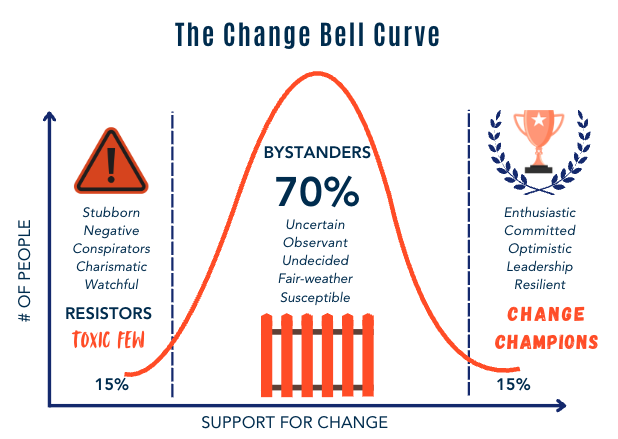
Any time you introduce significant change — through strategic planning, future visioning, restructuring, culture work, or community-wide initiatives — the same human dynamics tend to show up.
The Change Bell Curve is a practical leadership tool that helps us understand how people typically distribute themselves around a change effort.
Vertical axis: number of people
Horizontal axis: level of support for the change initiative
What the curve reveals is not simply who supports change and who resists it. It reveals where a leader must spend time, energy, and strategy.
1. Change Champions | roughly 15%
These are the people on the far-right side of the curve. They are enthusiastic, hopeful, and often ready to move before everyone else. They may include senior leaders, board members, team captains, early adopters, resilient staff, or people who are simply energized by possibility.
Champions matter. They create momentum. They offer energy. They help signal that a future is possible.
But here is the caution: Champions are not the majority. One of the most common leadership mistakes is assuming that because champions are visible and vocal, everyone else must be close behind. That is rarely true.
Also, your champions should not all think alike. You want conservers, pragmatists, and originators among them so you can learn how different people need to hear the case for change.
2. The Bystanders | roughly 60–70%
This is the middle of the curve, and it is the most important part.
Bystanders are not against the change. They are not fully committed to it either. They are uncertain, observant, and often waiting for evidence. They want to see whether the change is credible, whether leadership is serious, and whether the early adopters get rewarded or burned.
This is where most change efforts are won or lost.
Bystanders tend to ask:
Is this real?
Is it safe?
Will this last?
Are people like me buying in?
Does leadership actually know what it is doing?
Leaders often spend too little time with this group because bystanders are quieter than champions and less disruptive than resistors. But they are the hinge point. When the middle moves, the culture moves.
3. The Resistors / The Toxic Few | roughly 15%
On the far-left side of the curve are those firmly opposed to the change.
Their resistance may come from fear, loss of status, past disappointment, skepticism toward leadership, or simple preference for the familiar. Many are articulate. Many are influential. Many know exactly how to raise doubt in a room.
Their script is often familiar:
“We’ve tried this before.”
“This won’t work here.”
“Why do we need to change?”
“Leadership doesn’t understand how things really work.”
Some concerns from this group may contain useful information. Leaders should listen for signals. But leaders should not make the mistake of turning the entire strategy toward winning over people who have no intention of moving.
Do not spend the bulk of your time trying to convert the Toxic Few. You may end up amplifying their voice while starving the middle of the confidence it needs.