Why Roundtables Build Better Leaders
HB Weekly Leadership Brief
Week of April 27, 2026
There’s a reason elite athletes don’t just sit in classrooms and listen to lectures about fitness. They train together. They practice under pressure. They get coached in real time. They reflect, recover, and return stronger.
Leadership development works the same way.
Too often organizations rely on one-off workshops, passive webinars, or annual trainings and then wonder why behaviors don’t change. Information alone rarely transforms people. Real leadership growth happens through application, reflection, accountability, feedback, and social learning — leaders learning with and from one another.
That’s why the leadership roundtable model has become one of the most powerful tools we use at Harrington Brands. It blends short-form training, peer coaching, facilitated discussion, journaling, reflection, accountability work, practical experiments, and real-world leadership application into one integrated experience.
The result? Leadership development that actually sticks.
Not because people heard something once — but because they practiced it, discussed it, wrestled with it, reflected on it, and applied it alongside others navigating the exact same challenges.
A good leadership roundtable becomes more than training. It becomes a leadership tribe.
“Tell me and I forget. Teach me and I may remember. Involve me and I learn.”
— Benjamin Franklin
“None of us is as smart as all of us.”
— Ken Blanchard
By the Numbers
1. Social learning drives stronger retention: Research from the National Training Laboratories Learning Pyramid suggests lecture-based learning often results in only ~5% retention, while discussion groups, practice, and teaching others can dramatically improve learning retention and application.
2. Employees learn best from peers and managers: A 2025 LinkedIn Learning Workplace Learning Report found that employees consistently rank peer collaboration, coaching, and manager-led development as some of the most impactful forms of learning.
3. Psychological safety accelerates team learning: Research by Google Project Aristotle found that psychological safety — the ability to ask questions, admit mistakes, and learn openly — was the single greatest predictor of high-performing teams.
4. Reflection improves leadership growth: Studies from Harvard Business School found that individuals who spent structured time reflecting on learning experiences improved performance significantly more than those who simply continued working without reflection.
5. Coaching cultures outperform: Organizations with strong coaching and development cultures report higher engagement, retention, and adaptability according to research from International Coaching Federation and Deloitte.
Consult with Matt
One of the biggest myths in leadership development is that people change because they received information (“here is how you become a great leader”).
They don’t.
If information alone created transformation, every person who attended a conference would leave permanently changed. No shade being thrown on great conferences that can give you one or two nuggets to walk away with and consider. Equally, every leadership book would instantly create better managers and every compliance training would eliminate dysfunction forever.
But leadership isn’t memorization. It’s conditioning (because we’re human).
Conditioning requires repetition, reflection, challenge, conversation, vulnerability, and accountability.
At Harrington Brands, we’ve been developing and refining leadership roundtables because they create something lectures rarely can: adaptive learning environments where leaders grow together in real time.
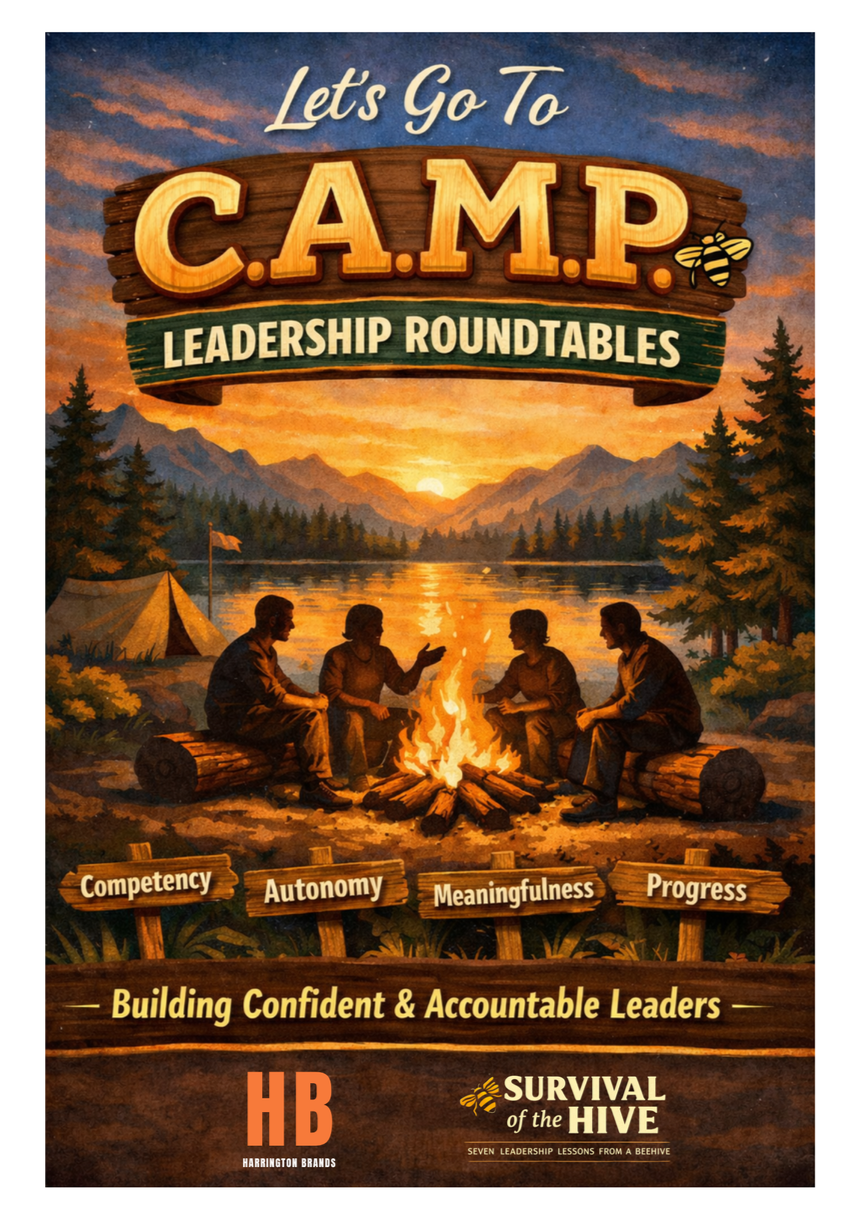
The C.A.M.P. Leadership Roundtable model is designed to create a core leadership tribe within an organization — a trusted peer group where supervisors and managers develop shared language, mutual accountability, stronger communication skills, and practical leadership tools together.
Unlike traditional training, the roundtable blends instruction, discussion, reflection, coaching, and application into one integrated leadership development process.
Each Roundtable Session (2 Hours) Includes:
45 Minutes — Leadership Training: Short, focused instruction introducing a practical leadership concept leaders can immediately apply. Examples include: Greenthumb Leadership, The Tyranny of the Urgent, Crucial Accountability Conversations, The Deep Ocean of Belief Systems & Behaviors, The Three R’s of Conflict Resolution, How Teams Develop
45 Minutes — Facilitated Group Discussion: Participants apply the concepts to real workplace situations and leadership challenges. This portion creates powerful peer-to-peer learning and allows leaders to learn from one another’s experiences.
30 Minutes — Breakout Exercises & Leadership Application: Participants work through leadership scenarios, coaching exercises, and reflection activities.
Between Sessions: Leadership growth continues between meetings through structured reflection and practical application work. Participants complete leadership journaling (10–20 minutes), reading assignments (e.g. Crucial Accountability, Good To Great, etc.), peer dialogue within the cohort, observation and application exercises
These activities reinforce learning, build leadership habits, and help move concepts from theory into daily practice.
Over time, the roundtable becomes more than training. It becomes a leadership culture-building system. That combination is incredibly powerful.
Frankly, it’s the crème de la crème of leadership development.
It’s a cocktail of:
Training
Coaching
Accountability
Reflection
Team building
Psychological safety
Real-world application
Peer mentorship
And importantly — it reduces leadership isolation. Many supervisors feel alone. Especially middle managers. They carry stress upward and downward simultaneously
Roundtables remind leaders: “You’re not the only one dealing with this.”
Perhaps the most powerful element is the fact that roundtables can create a shared leadership culture.
Over time, leaders stop operating as disconnected individuals and begin developing common language, expectations, frameworks, and behaviors.
Suddenly conversations become:
“This feels like a trust bank account issue.”
“I think I’m stuck in the tyranny of the urgent.”
“This employee probably needs a different CAMP approach.”
“I may be climbing the ladder of inference.”
“I’m currently too dysregulated to handle this appropriately.”
That’s when leadership development stops being theoretical and becomes human and operational.
In today’s chaotic workplace environment where burnout, uncertainty, conflict, and complexity are constant, organizations desperately need leaders who can think adaptively instead of react emotionally.
The future won’t belong to organizations with the most policies. It will belong to organizations that build leaders capable of learning together.
Weekly Reflection
Journal Prompt #1: Where in my leadership am I trying to “lecture” people into growth instead of coaching, developing, and walking alongside them?
Journal Prompt #2: Who are the 2–3 leaders or peers I genuinely learn best from right now — and why?
Journal Prompt #3: What leadership challenge am I currently carrying alone that would benefit from trusted peer discussion?
Direct Application
Leadership Reps for the Week
Rep 1: Build Your Leadership Tribe
Identify 3 people inside your organization (or outside of it) who sharpen your thinking. Reach out to one this week for an intentional leadership conversation.
Rep 2: Replace One Lecture with One Dialogue
The next time a team issue arises, resist immediately solving or lecturing. Ask:
“What do you think is really happening here?”
“What are we missing?”
“How would you approach this?”
Rep 3: Schedule Reflection Time
Block 20 uninterrupted minutes this week to reflect on:
What leadership challenge is repeating?
What patterns are emerging?
What lesson keeps trying to teach you something?