The Hidden Chain Behind Innovation and Conflict
HB Weekly Leadership Brief
Week of May 18, 2026
Real innovation is messy.
Few organizations are willing to build the emotional and cultural conditions required to actually produce it.
Innovation, by its very nature, requires disagreement. It requires uncertainty. It requires people saying things out loud that may not work, may not be popular, or may challenge the status quo. And the moment human beings begin challenging assumptions, introducing new perspectives, or pushing against old ways of thinking, something naturally appears: conflict.
That is where many organizations panic.
Instead of seeing tension as a natural byproduct of growth, leaders often rush to eliminate it. Meetings become artificial. Harmony becomes performative. Teams start protecting feelings instead of pursuing truth. Eventually, organizations unknowingly create cultures where people remain polite, agreeable, and emotionally safe on the surface, but innovation quietly dies underneath.
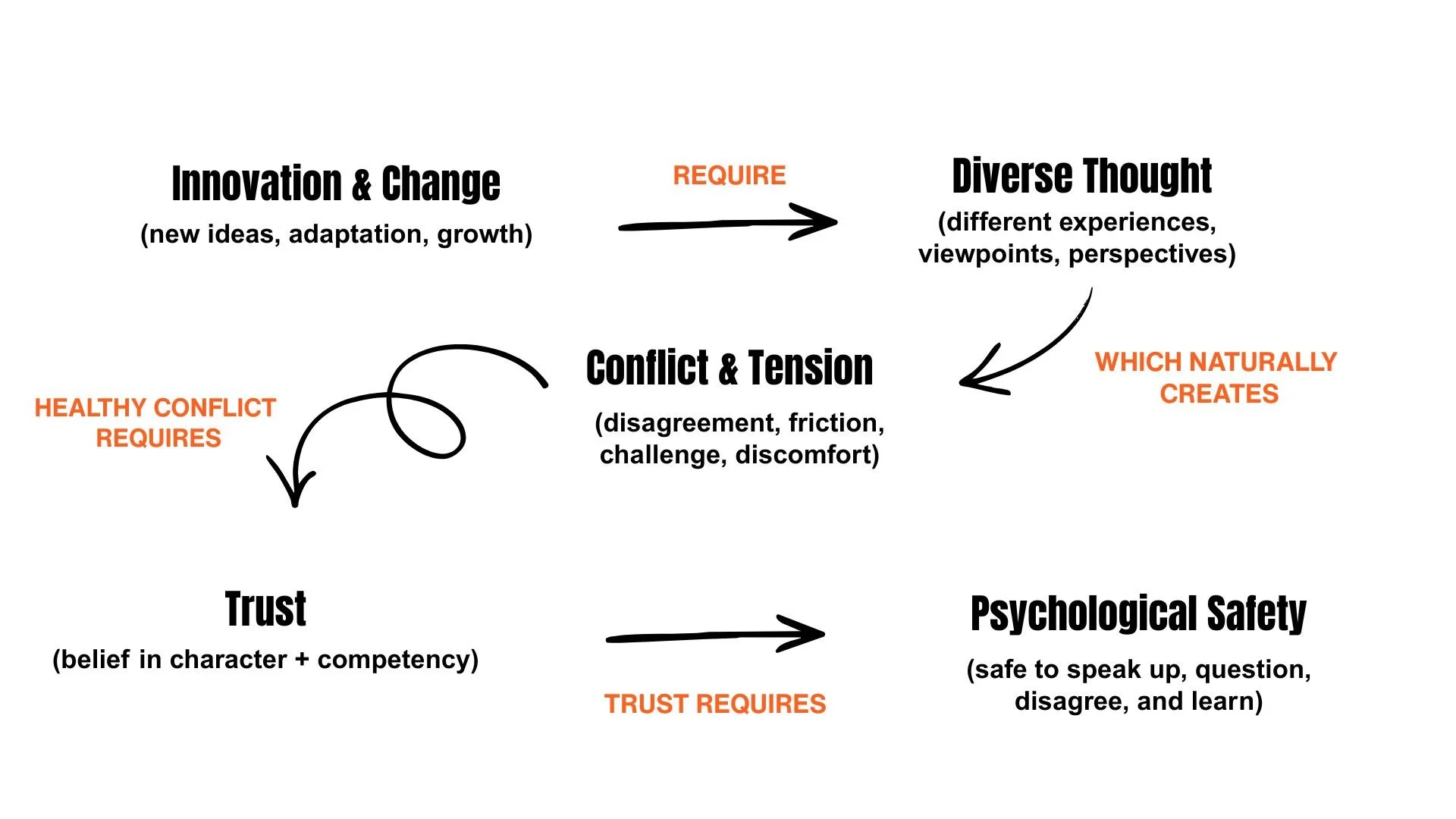
There is a simple but powerful chain reaction that I believe sits underneath nearly every healthy, high-performing culture:
Innovation and change require diverse thought. Diverse thought naturally creates conflict. Healthy conflict requires trust. Trust requires psychological safety.
This is a law of organizational gravity.
If you want innovation, you must first tolerate diversity of thought. That means allowing people with different experiences, personalities, communication styles, generations, educational backgrounds, and perspectives to truly participate.
But diverse thought is inherently disruptive.
Different viewpoints create friction. Different priorities create tension. Different interpretations create disagreement. In healthy organizations, that conflict becomes productive dialogue. In unhealthy organizations, it becomes avoidance, silence, gossip, passive aggression, or political maneuvering.
Patrick Lencioni has long argued that the absence of trust creates a fear of conflict. Brené Brown reminds us that vulnerability is the birthplace of creativity and innovation. Amy Edmondson’s work on psychological safety demonstrates that high-performing teams are not the teams without mistakes or disagreement, but the teams where people feel safe enough to speak up, question, challenge, and learn.
All of these ideas point to the same reality: healthy conflict cannot exist without trust.
And trust itself is fragile. Stephen Covey describes trust as built upon both character and competency — integrity, intent, capabilities, and results. People are constantly asking two subconscious questions of leadership:
Can I trust your intentions?
And can I trust your judgment?
If either answer becomes shaky, conflict immediately becomes dangerous rather than productive.
This is why psychological safety matters so much.
Psychological safety is not about lowering standards or creating comfort at all costs. It is not about removing accountability or avoiding difficult conversations. In fact, the healthiest teams often have the highest standards.
Psychological safety simply means people believe they can:
speak honestly,
ask questions,
admit mistakes,
challenge ideas,
and contribute authentically without fear of humiliation, retaliation, or emotional punishment.
Without psychological safety, people begin managing risk socially instead of intellectually. They stop raising concerns. They stop challenging bad ideas. They stop innovating.
And eventually, organizations drift toward artificial harmony.
This chain also works in reverse.
Psychological safety helps create trust. Trust allows healthy conflict. Healthy conflict sharpens diverse thought. Diverse thought fuels innovation and change.
In other words, innovation is not merely the output at the end of the chain — it also becomes fuel for the beginning.
Healthy innovation cultures become self-reinforcing systems.
The moment teams successfully navigate difficult conversations together, trust grows. The moment trust grows, psychological safety deepens. The moment safety deepens, people become more willing to contribute ideas, challenge assumptions, and engage honestly.