Tyranny of the Urgent
HB Weekly Leadership Brief
Week of March 30, 2026

The Tyranny of the Urgent is not simply a time-management problem, it is a leadership problem. It shows up when visible, noisy, emotionally loaded, short-horizon demands consistently displace slower, less dramatic, but more consequential work: strategy, talent development, culture, thinking, renewal, and the future.
The tyranny of the urgent is the repeated surrender of mission-critical work to short-term pressures that feel immediate but do not deserve disproportionate control over attention, energy, and decision-making.
Let’s dig into it this week.
“Your greatest danger is letting the urgent things crowd out the important.” - Charles E. Hummel
“Putting first things first means organizing and executing around your most important priorities.” - Stephen R. Covey
By The Numbers
PwC’s 29th Annual Global CEO Survey (2026) found CEOs spend 47% of their time on issues with a time horizon of less than one year, compared with just 16% on issues more than five years out.
A 2024 Journal of Occupational Health study of office workers found that more frequent interruptions significantly increased subjective workload, especially when employees were engaged in complex tasks.
Microsoft Research’s 2023 CHI study found that workers given protected focus time reported higher performance, greater immersion, and better job resources.
Gloria Mark, Daniela Gudith, and Ulrich Klocke’s study The Cost of Interrupted Work: More Speed and Stress finds that it takes about 23 minutes to return to a task after an interruption.
Consult with Matt
The phrase “tyranny of the urgent” is most closely associated with Charles E. Hummel, whose well-known booklet helped popularize the idea that urgent demands can crowd out what matters most. The broader leadership lineage runs through Dwight Eisenhower’s distinction between the urgent and the important, Peter Drucker’s focus on executive effectiveness, Stephen Covey’s urgent-important matrix, John Kotter’s distinction between true urgency and false urgency, Greg McKeown’s call for disciplined prioritization, and Cal Newport’s defense of deep, distraction-free work.
The research reinforces what many leaders already feel. Studies show that people often choose urgent tasks over objectively more important ones, a bias now known as the “mere urgency effect.” Research also shows that interruptions and attention switching degrade performance, time pressure can weaken decision quality and increase risky choices, and workplace telepressure can undermine recovery and contribute to burnout.
I was recently speaking with another executive when this issue came up. A staff member of theirs had been asked to attend an important meeting with a third-party vendor. Given the circumstances, it was already expected to be a tense and delicate conversation. The executive and the vendor waited, but the staff member never arrived.
Later, assuming something urgent must have pulled the person away, the executive followed up and asked what had happened. The staff member explained that someone had stopped them in the hallway and drawn them into a conversation. As the executive looked into it further, it became clear that the hallway exchange was neither critical nor time-sensitive.
What happened was a classic example of the tyranny of the urgent. Instead of staying focused on the truly important responsibility in front of them, the staff member was pulled off course by what was immediate, visible, and convenient. The most important work was not ignored out of malice or laziness. It was displaced because the urgent moment right in front of them felt more pressing than the meaningful commitment already on the calendar.
At its simplest, the tyranny of the urgent is a pattern in which short-term, immediate, visible demands repeatedly overpower long-term, meaningful, strategic responsibilities. The urgent feels loud. The important is often quieter. One arrives as a notification, interruption, request, crisis, or deadline. The other shows up as planning, relationship-building, leadership development, writing, deep thinking, prevention, or disciplined follow-through.
That imbalance matters because urgent work is not automatically trivial. Some urgent work is genuinely essential. The problem begins when urgency becomes the default operating logic of a leader, team, or institution. In that environment, people stop asking, “What matters most?” and start asking, “What is on fire now?” Over time, that creates a reactive culture that mistakes motion for progress.
Urgency is not just a rational response to real deadlines. It has emotional and cognitive pull. Leaders should not assume that urgent-task preference reflects wise tradeoffs. Often, people are simply reacting to what feels pressing in the moment.
A Culture of Urgency
Many organizations build urgency directly into the architecture of work. Notifications, ad hoc meetings, pings, Slack messages, and constantly shifting inbox demands create a fragmented cognitive environment. In that kind of environment, leaders may feel productive while actually generating more stress, lower-quality attention, and shallower decision-making.
Organizations trapped in urgency tend to over-reward responsiveness, under-invest in reflection, and slowly surrender strategic work to whatever shouts the loudest. The antidote is not laziness or delay. It is disciplined priority, protected thinking time, clearer boundaries, thoughtful operating rhythms, and the courage to act on what is important before it becomes urgent.
Urgency also does not stay neatly contained within office hours. When leaders or cultures imply that rapid response is always expected, urgency follows people home. That erodes recovery, increases burnout, and slowly undermines the human capacity needed for judgment, steadiness, and creativity.
Common Signals of the Tyranny of the Urgent
Meetings dominate the week, but strategic conversations keep getting postponed.
Leaders celebrate responsiveness more than reflection, prevention, or discernment.
The inbox and calendar become the de facto strategy.
Coaching, writing, talent development, culture work, and planning are treated like luxuries.
People feel perpetually busy, yet strangely unsure that the most important work is advancing.
The organization becomes excellent at handling interruptions and mediocre at shaping the future.
This is why the issue matters so much for leadership. The tyranny of the urgent does not merely waste time; it shapes culture. It teaches people what really matters by what repeatedly gets protected, rewarded, answered first, or postponed.
Practical Antidotes for Leaders
The goal is not to eliminate urgent work. The goal is to stop letting urgency rule everything.
Use an urgent-important lens in weekly planning. Identify the high-value, non-urgent work that must move this week.
Audit where leadership time actually goes. Drucker’s advice still holds: start with time, not aspirations.
Protect deep-work blocks for writing, thinking, strategy, design, and development work. Do not leave them as leftover time.
Reduce interruption architecture where possible. Batch communication, clarify response expectations, and challenge the assumption that instant availability equals commitment.
Create boundaries around telepressure. A healthy team should know what truly requires a rapid reply and what can wait.
Review recurring “fires” for systemic causes. Repeated urgency is often a design problem disguised as a heroism problem.
Reward discernment, not just speed. Celebrate leaders who reduce noise, clarify priorities, and make the next crisis less likely.
Leaders must not wait for the important to become urgent before they honor it. The best leadership work is often quiet before it is obvious. It is usually preventive before it is dramatic. It rarely arrives with the emotional force of a crisis. That is precisely why it must be chosen deliberately.
Weekly Reflection
What important work in my role keeps getting postponed because it does not scream loudly enough?
What does my calendar reveal about my real priorities?
Where has urgency become culture instead of exception?
What requests only feel urgent because someone else is uncomfortable waiting?
What would become stronger in this team if we protected depth, reflection, and prevention more fiercely?
Direct Application
This week, train against the tyranny of the urgent. Do not just admire the idea. Practice it!
Protect one block of deep work: Schedule one 60–90 minute block this week for your most important non-urgent work: strategy, planning, writing, coaching, or thoughtful decision-making. Treat it like a critical meeting, not optional time.
Audit your interruptions: For two workdays, keep a simple note of what pulls you off track: pings, hallway conversations, email, texts, meetings, drop-ins, or your own impulse to switch tasks. At the end, ask: Which of these were truly urgent, and which merely felt urgent?
Move one important thing before it becomes a fire: Choose one meaningful responsibility you have been postponing — a tough conversation, staff development issue, strategic priority, process fix, or follow-through item — and make visible progress on it this week.
Reset one team expectation around responsiveness: Clarify one boundary with your team: when immediate replies are actually needed, when they are not, and what deserves protected focus time. Healthy urgency is useful. Constant urgency is corrosive.
End the week with a leadership check-in: Before Friday ends, ask yourself: Did I lead my week, or did my week lead me? Write down one way you honored what was important and one way urgency still stole too much ground.
Leadership Tool of the Week
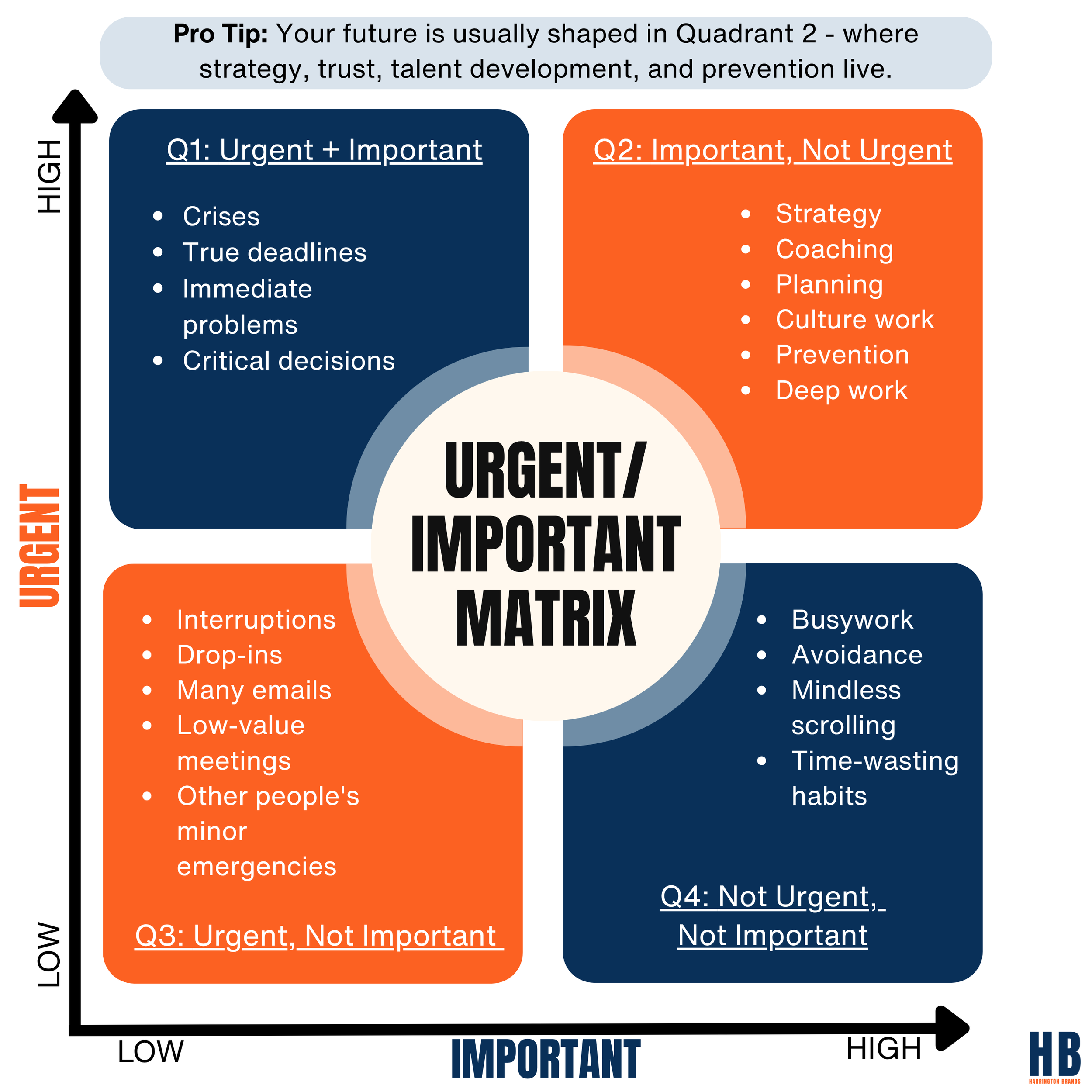
The Urgent-Important Matrix
This week’s leadership tool is the Urgent-Important Matrix, a simple but powerful framework rooted in Dwight Eisenhower’s thinking and later popularized by Stephen Covey. It helps leaders separate what is loud from what is truly valuable.
At its core, the matrix asks you to sort your work, decisions, and demands into four categories:
Quadrant 1: Urgent and Important
These are the true fires: crises, deadlines, immediate problems, and critical decisions.
Quadrant 2: Important but Not Urgent
This is where the best leadership work lives: strategy, coaching, planning, culture work, prevention, deep thinking, and development.
Quadrant 3: Urgent but Not Important
These are the distractions disguised as leadership: interruptions, many emails, drop-ins, low-value meetings, and other people’s minor emergencies.
Quadrant 4: Neither Urgent nor Important
This is the realm of busywork, avoidance, and time-wasting habits.
The leadership lesson is simple: your future is usually shaped in Quadrant 2. That is where trust is built, talent is developed, culture is strengthened, and problems are prevented before they become crises.
The danger, of course, is that many leaders spend too much of their time trapped between Quadrant 1 and Quadrant 3 — handling real fires while also reacting to noise. Over time, that is how the tyranny of the urgent takes hold. The inbox becomes the strategy. The calendar becomes the boss. The loudest thing wins.
This week, take 10 minutes and list everything currently pulling at your attention. Then sort each item into one of the four quadrants.