Weekly Posts and Insights

Don’t Empower Too Early
Real empowerment is not the first move of leadership development. It is the earned result of a process. First, we include people in meaningful spaces. Then we engage them in real work with support. Then, over time, we empower them to own it. That is how mature workers are formed. That is how confidence becomes competency. And that is how leaders stop mistaking exposure for readiness.
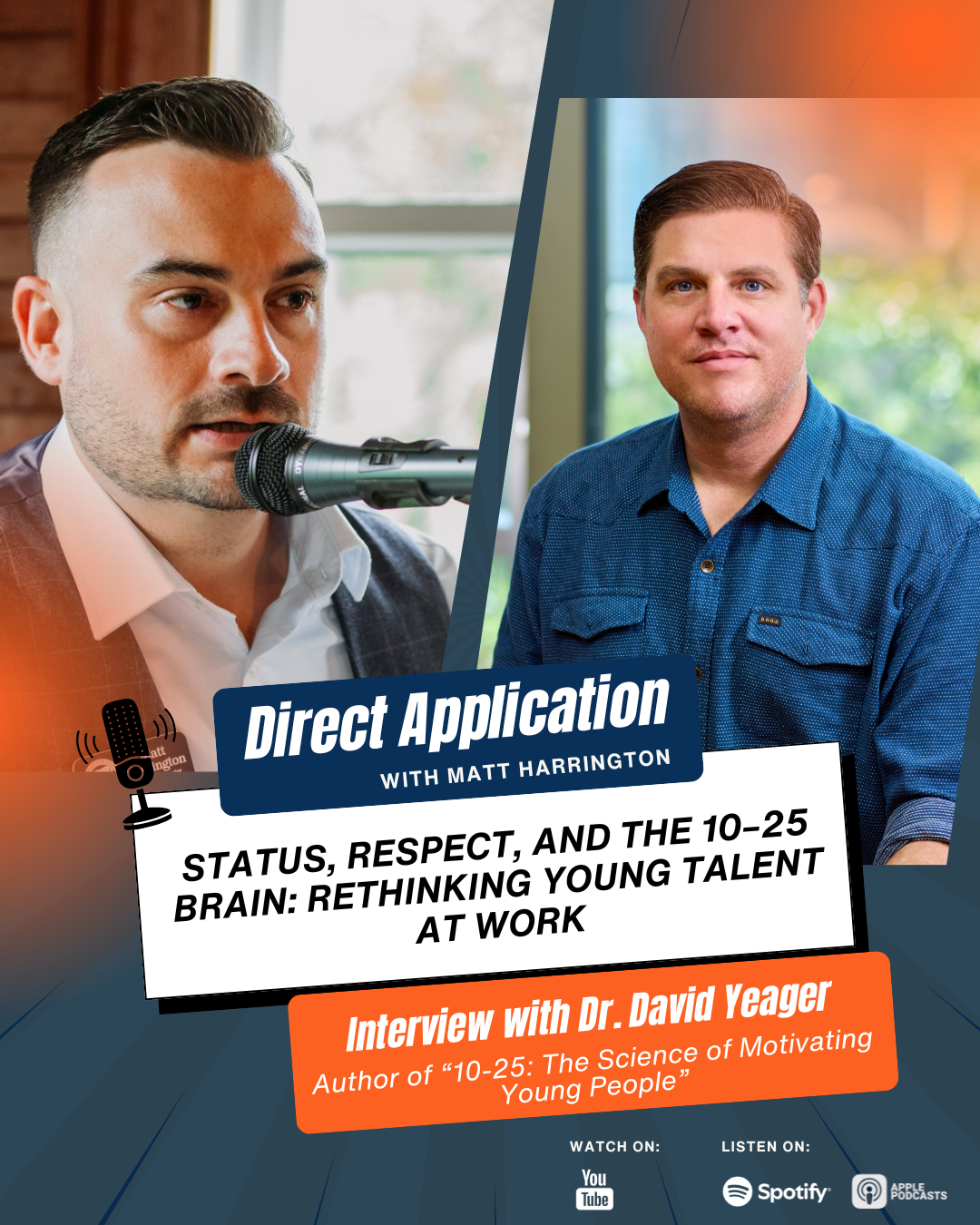
Status, Respect, and the 10–25 Brain: Rethinking Young Talent at Work I Season 1 Finale of Direct Application with Matt Harrington
In the Season 1 finale of Direct Application, host Matt Harrington sits down with Dr. David Yeager, bestselling author of 10–25: The Science of Motivating Young People, for a timely and practical conversation on leadership, motivation, and the future of work.
Dr. Yeager’s research challenges one of the most common — and costly — assumptions in organizations today: that young people ages 10 to 25 are inherently immature or incompetent. Instead, he reframes adolescence and early adulthood as a distinct developmental window where status, respect, belonging, and purpose are the primary drivers of engagement and performance.
Together, Matt and David explore how leaders, managers, and organizations can apply these insights directly in the workplace — without lowering standards or sacrificing results.

How to keep from losing good young leaders at your organization
raditionally, corporations have long talked about the leadership ladder - each rung of the proverbial ladder equaling a new role, title, pay, and/or leadership level. Unfortunately, that’s quite an outdated model and just doesn’t work for the new worker.
When we look at the Leadership Growth Lattice, it functions like the name. Instead of straight up, its sprawls out like a garden lattice. It assists in creating a “holistic” employee with multiple dimensions of growth, service and leadership.
Imagine a lattice and the buckets you may want an employee to think about as they grow within your organization.