Trust and Credibility and Why They Still Matter

When we talk about what makes communities and organizations truly successful, the first place we should look isn’t strategy documents, technology stacks, or growth plans. It’s our people — and more specifically, how we lead them.
Organizations that thrive don’t do so because they’re well-funded, have better technology, or are lucky; they do so because they have the right leaders in the right positions, leaders who are able to capitalize on talents, communicate a clear and compelling vision, rally support — and build trust.
This was true yesterday. It’s true today. It will be true tomorrow.
In recent years, many commentators have warned that trust in leaders is declining. Feels like that doesn’t it? Surveys like the 2025 Edelman Trust Barometer show widespread skepticism about authority figures, with a significant percentage of people believing business leaders are misleading or untrustworthy. Gallup’s workplace research finds that only about one in five U.S. employees strongly agree they trust their organization’s leadership. These statistics can make it feel like trust is slipping through our fingers as a leadership competency.
But here’s the important counterpoint: even in a world where blanket trust in institutions is shaky, people still place high value on trustworthy leadership at the local and organizational level. When leaders get trust right, teams engage more deeply, motivation becomes intrinsic rather than transactional, and performance improves measurably. Research consistently shows that people who feel treated with respect and who trust their leaders are more engaged, productive, and committed.
So how do the best leaders build trust? And what is trust, exactly?
At its core, trust is the firm belief in the reliability, truth, ability, or strength of someone or something. While often spoken about abstractly, trust has very real and measurable implications.
One of the most practical and enduring frameworks for understanding trust comes from Stephen M. R. Covey, a renowned author and expert on the subject. Covey describes trust as the act of building credibility, and he identifies four “cores” that are essential to credibility: integrity, intent, capabilities, and results.
Covey further groups these four cores into two broader categories: character and competency. Character is made up of the moral qualities and values distinctive to an individual, while competency is the ability to do something successfully or efficiently. Integrity and intent fall under character; capabilities and results fall under competency. All four cores are necessary for credibility and therefore for trust. When trust is broken, it is always because one or more of these elements has failed.
Most major violations of trust, Covey argues, are violations of integrity. Integrity, however, is more than honesty alone. It also includes congruence between our values and our behavior.
Intent flows directly from character. It is rooted in our value system and reflects how we believe we should act. Intent has three components: our motives (why we do what we do), our genuine care for the people we interact with, lead, or serve, and our perception of someone else’s intent — along with how that perception influences our willingness to trust them. In leadership roles, intent is often the most misunderstood core: leaders may believe their intentions are clear, while others experience them very differently.
The competency side of trust is equally important. Capabilities are “the talents, skills, knowledge, capacities, and abilities that we have that enable us to perform with excellence.” They answer the unspoken question people are always asking of leaders: Do you know what you’re doing?
Results are the deliverables. They are what you contribute to the organization, the brand, and the relationship. Results are visible, measurable, and difficult to hide from. Over time, trust grows when leaders are seen as predictable and consistent in what they deliver.
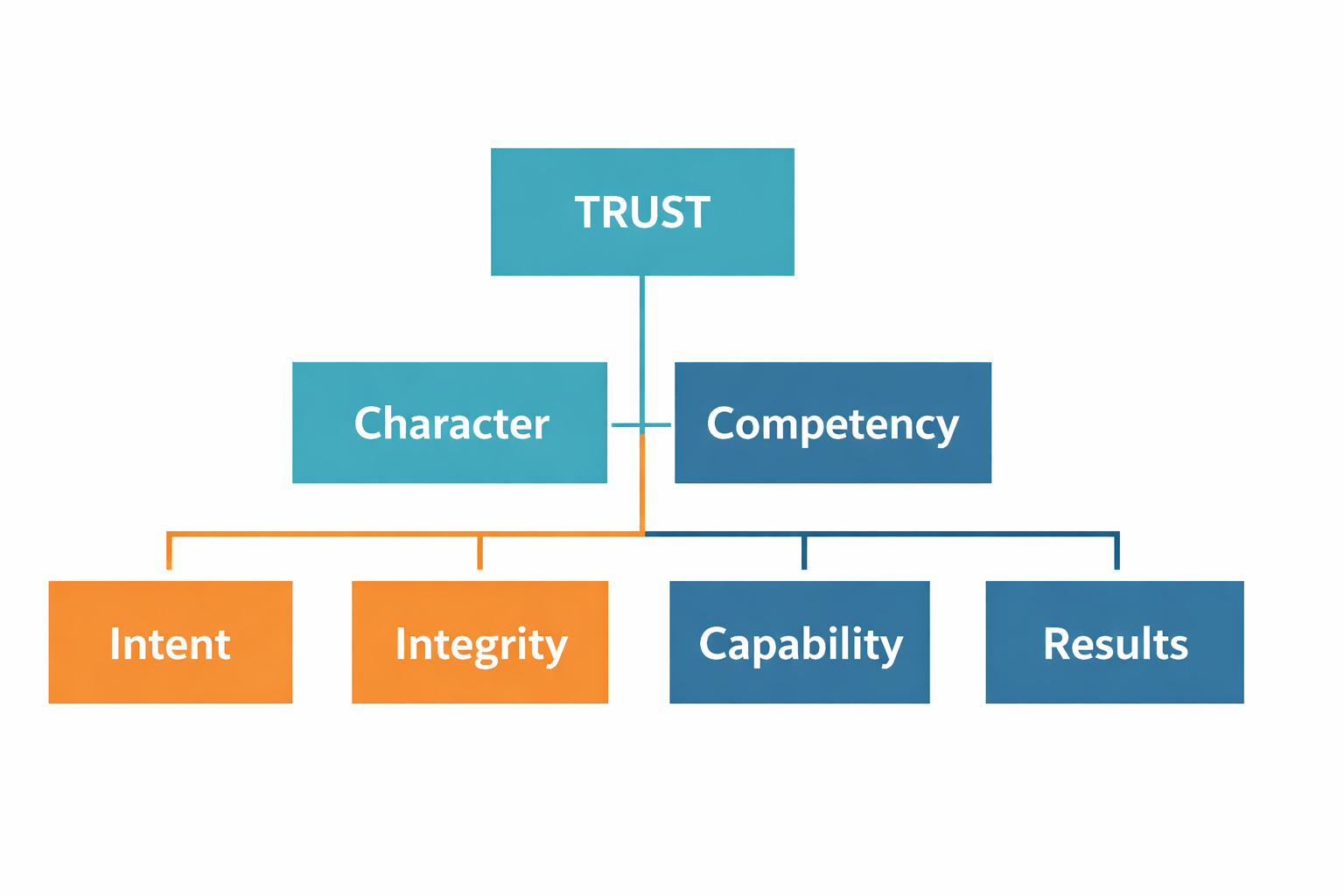
Ultimately, trust is not built in a single moment; it is built through repetitive performance in both competency and character. When trust is lacking, it is because one or more of these elements is missing from the formula.
A helpful way to think about trust is as a bank account. When any new relationship begins — whether with a new community, a new colleague, or a new organization — the account presumably starts at zero. Neither party has made any deposits yet, and trust is naturally low. People may still be polite and outwardly cooperative to meet social norms, but they are unlikely to be vulnerable or fully honest.
As time goes on, every interaction either adds to the account or withdraws from it. If we begin with nothing and repeatedly make withdrawals, trust breaks quickly and the relationship often dissolves — what we call trust bankruptcy. On the other hand, when leaders consistently demonstrate character and competency through integrity, intent, capabilities, and results, the trust account grows.
Building trust requires showing up — on time, prepared, and ready to engage — again and again. It requires repetitive performance, not one-time gestures.
When a trust account is healthy, it can also withstand occasional withdrawals. A sincere “I’m sorry I’m late” with a good friend or trusted colleague is usually forgiven because the relationship has equity. Even the apology itself can function as a deposit. But when lateness becomes habitual, the account begins to drain, and people start to say, “I just don’t trust that this won’t keep happening.”
The same dynamic applies to organizations and brands. One bad meal at a favorite restaurant often leads us to assume something was off that night. When trust has been built over time, there is breathing room for error. Strong, sturdy relationships — personal or professional — are resilient precisely because trust has been consistently earned.
For leaders, the lesson is clear: trust is not accidental, and it is not soft. It is built through daily choices, repeated behaviors, and a steady alignment of character and competency. When leaders understand and practice this, trust becomes a powerful driver of motivation, engagement, and long-term success.
Direct Application This Week:
Identify one decision, change, or expectation and explicitly state why you’re doing it, who it’s for, and what success looks like. Then ask for reflection, not agreement.
Choose one promise—big or small—and deliver on it early or publicly. Consistent results are one of the fastest ways to rebuild or strengthen trust.
Make one intentional “trust” deposit with a coworker: recognition, clarity, availability, or support.
For leaders looking to put these ideas into practice and strengthen trust, resilience, and engagement within their teams, explore our e-book:
Revitalize and Retain Staff – Strategies for Boosting Employee Resilience and Engagement