When Burnout and Aversion to Challenges Become the Culture

I was with a group of community leaders recently, and the conversation turned toward staffing, morale, and what someone described as an “aversion to challenges” culture. One leader, only a few weeks into their new leadership job, had already noticed something heavy in the air: depression, victimhood, blame, and a general displeasure whenever the team encountered difficulty. The group acknowledged the real burnout, stress, exhaustion, and emotional residue of the past several years, but also wondered whether those realities had slowly become the default language and culture of the workplace.
At some point, I asked a question: “Does it feel like we’ve been having this same conversation since the pandemic? Maybe we’re just not good at going to work and doing the work anymore?!” We all had a good chuckle.
When Burnout Becomes the Workplace Culture
I don’t say that to be dismissive. Work has been hard. People have carried the weight of a pandemic, economic uncertainty, housing pressure, inflation, childcare instability, wage frustration, and a general sense that the old social contract is no longer holding. The data backs up the mood: global engagement remains low, U.S. engagement is strained, and many middle-income workers have watched nominal wages rise while real buying power has grown far more slowly.
The Leadership Tension: Validating Stress Without Organizing Around It
So yes, the frustration is real. But here is the leadership tension: at what point does acknowledging hardship turn into organizing our culture around hardship?
For every public conversation about burnout, resilience, flexibility, and balance, there is a quieter employer conversation happening behind the scenes: Why does every challenge now feel like an offense? Why does normal difficulty so quickly become proof that the system is broken? Why are so many teams struggling to move from complaint to solution?
That does not mean people are lazy. It does not mean leaders should ignore burnout. And it certainly does not mean we should romanticize old models of work where people quietly suffered and called it professionalism. But many organizations are facing a cultural shift. We have spent years naming stress and validating exhaustion, much of which was necessary. But naming pain is not the same as building capacity. Validation is not the same as agency. And a culture that only gets good at identifying what is wrong may eventually forget how to build what is next.
When Effort No Longer Feels Like It Leads Somewhere
Social dominance theory, developed by Jim Sidanius at Harvard and Felicia Pratto at the University of Connecticut, offers a useful lens here. Their research explores how societies maintain hierarchy through what they call “legitimizing myths” — widely accepted stories that explain why people hold different levels of power, status, or success.
One of America’s dominant legitimizing myths has long been meritocracy: work hard, develop your talent, stay committed, and you can improve your life.
For many workers, that myth has been damaged. When housing feels out of reach, wages feel flat against inflation, childcare feels impossible, and advancement feels slower than promised, people begin to question the basic social agreement.
The danger is not that people are questioning the myth. The danger is what fills the vacuum when belief collapses.
When people stop believing effort leads somewhere, they often protect themselves. They lower commitment. They narrate every challenge as evidence that the organization does not care. They wait for someone else to fix it. Inside organizations, that can look like teams that identify problems faster than they build solutions, staff cultures that treat discomfort as dysfunction, and workplaces where every new initiative is met with suspicion.
From Complaint Culture to Solution-Focused Leadership
A solution-focused culture does not deny pain. It simply refuses to make pain the final identity of the organization. This is where leaders need to borrow more from entrepreneurial thinking. Entrepreneurial cultures are not places where everyone starts a business. They are cultures where people develop the habit of ownership. They learn to test, adapt, problem-solve, and move. They see a red flag and surface it early. They try something small before debating something forever. They treat resources as precious and reality as workable.
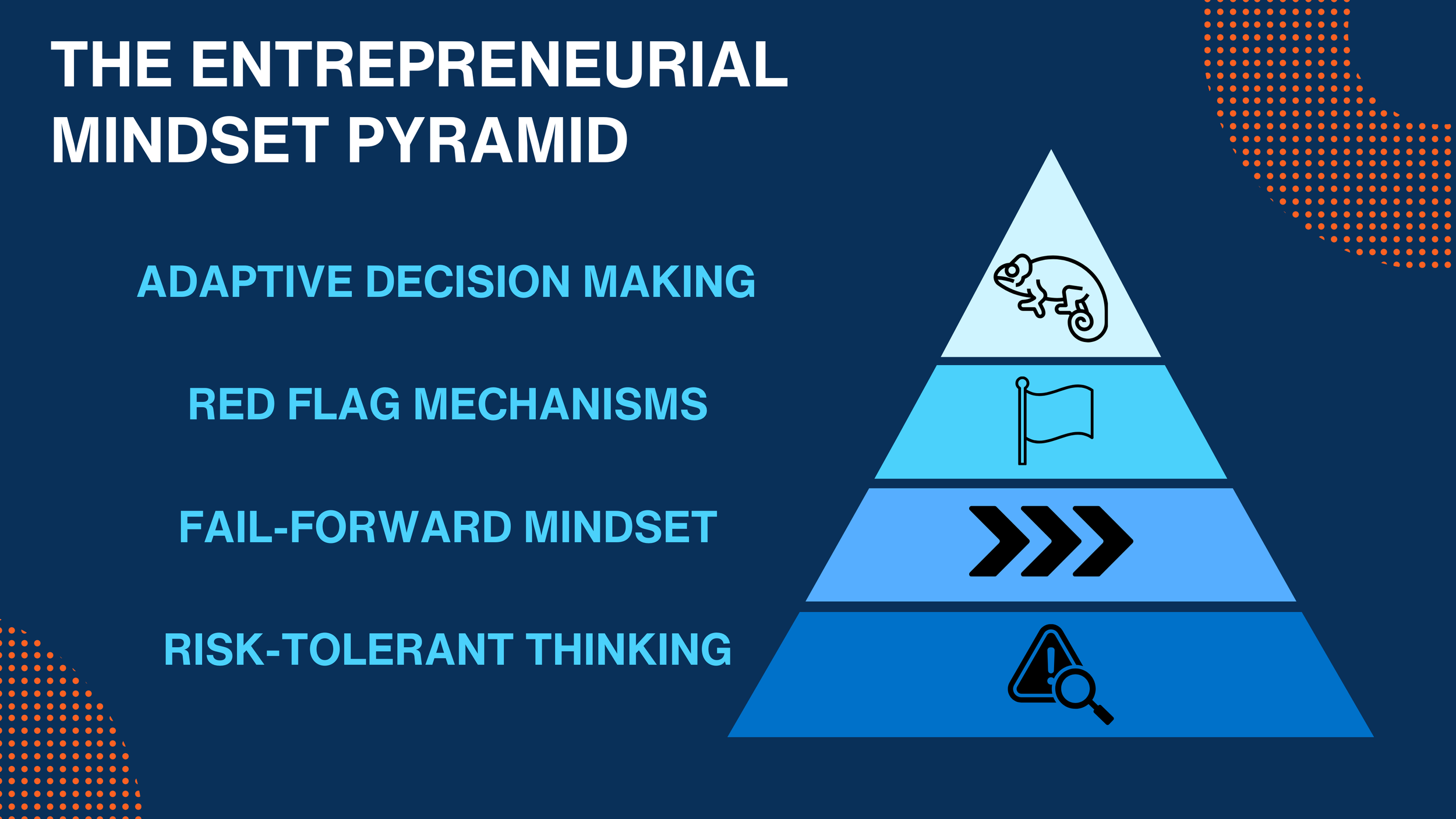
I’ve described this type of culture before through the Entrepreneurial Mindset Pyramid: starting at the base with risk-tolerant thinking, followed by a fail-forward mindset, then red flag mechanisms, and adaptive decision-making at the top. This means helping people act without perfect certainty, learn from what does not work, detect problems before they become crises, and pivot based on new information instead of staying trapped by old decisions simply because they were once comfortable.
One practical way to build this is through the development of “mini business units.” Instead of treating the organization as one large, slow-moving machine, divide work into smaller, more autonomous units where each team understands its goals, performance measures, resources, and connection to the larger mission. Large systems often produce learned helplessness. People complain because they do not believe they can influence the outcome. They wait because they do not believe they have permission. They blame because ownership is too diffuse.
Rebuilding Agency Through Ownership and Mini Business Units
Mini business units change the psychology. When a small team owns a project, service line, customer experience, event, financial budget, department function, or measurable outcome, the conversation shifts from “they should fix this” to “what are we going to try?”
This is not about dumping more work on staff. It is about restoring the connection between effort and outcome. It is about helping people see that their decisions matter. It is about turning vague frustration into localized ownership.
If your team is constantly complaining, one possibility is that they are immature, burned out, or cynical. Another possibility is that your structure has trained them to be powerless. Leaders should be honest enough to examine both.
Being a leader right now, at work, in your community, at home, is not about scolding people back into toughness or to indulge every complaint as sacred. The move is to rebuild agency with empathy and standards, listening and expectation-setting, honesty about the pressure people are under, and equal honesty that the job is still to solve, serve, and build something better than the condition we inherited.
The question for leaders is simple: Is your culture built around describing the problem, or solving it?
Because change is not slowing down. The organizations that survive will not be the ones with the most sophisticated complaints. They will be the ones that can still look at a challenge, gather the right people, test a better way, and move forward.