Taking the temperature of your organization this Spring
HB Weekly Leadership Brief
Week of April 13, 2026
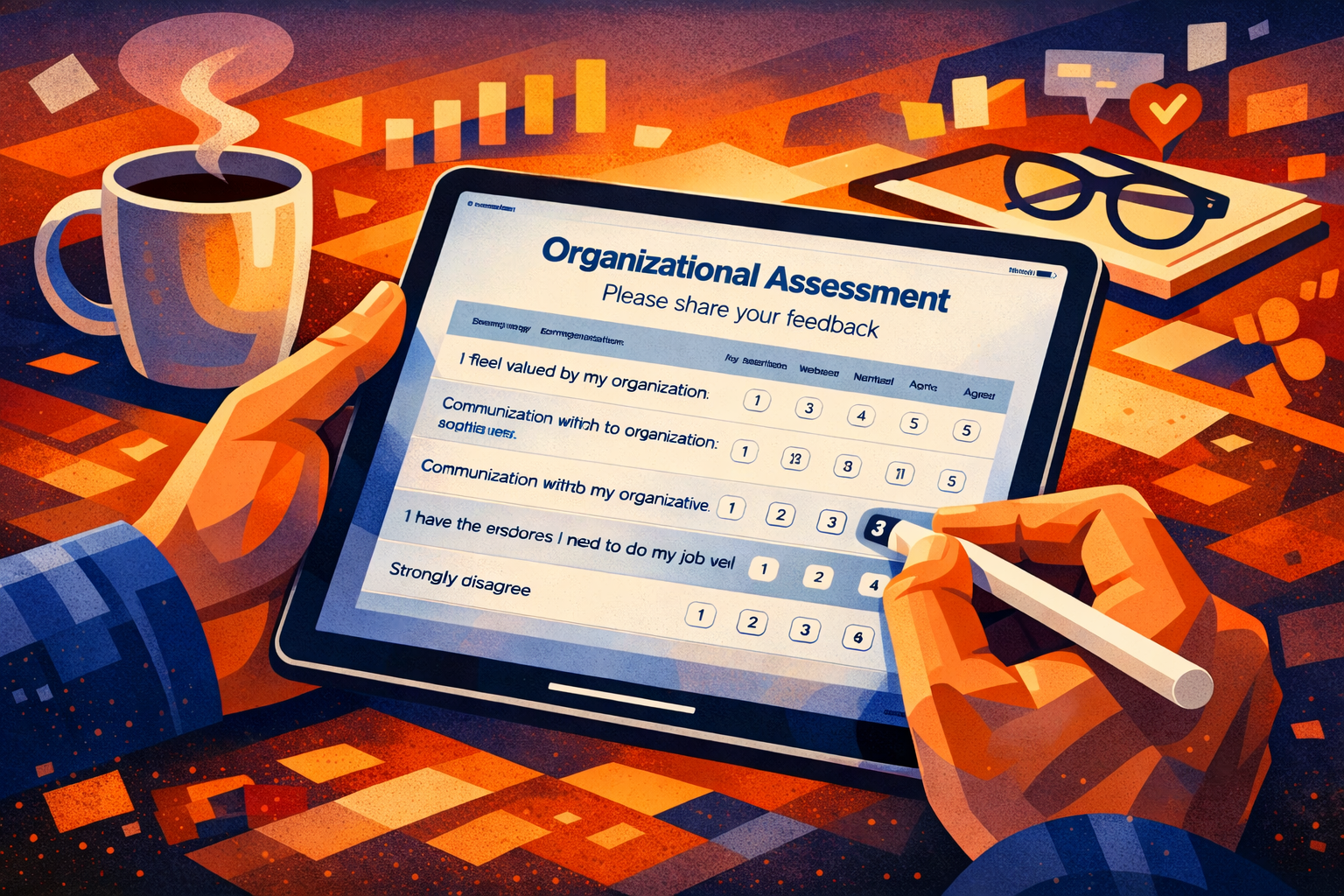
Every organization has a temperature.
Sometimes it is energized, focused, and clear. Sometimes it is anxious, overextended, disconnected, or quietly simmering beneath the surface. The challenge for leaders is that temperature is not always visible in the meeting agenda, the budget report, or the smiling faces in the hallway.
That is where assessments matter.
A good organizational assessment is not about catching people. It is about listening to the system. It helps leaders move beyond assumptions, anecdotes, and the loudest voices (or deepest pockets, influence, charm) in the room. It gives shape to what people are feeling, where alignment is breaking down, and where energy is either being created or drained. Done well, it can take the temperature, release some of the pressure, and create a healthier path forward.
Sometimes the bravest thing a leader can do is ask the question everyone has been carrying around but no one has quite named.
“In God we trust; all others must bring data.”
— W. Edwards Deming
“Without data, you’re just another person with an opinion.”
— W. Edwards Deming
“The most dangerous kind of waste is the waste we do not recognize.”
— Shigeo Shingo
By The Numbers
According to Perceptyx’s 2025 Employee Engagement Surveys, 75% of organizations now listen to employees at least quarterly, up from just 18% that surveyed more than once per year a decade ago. The strongest organizations are no longer treating assessment as an annual event. They are building listening into the rhythm of leadership.
Perceptyx’s2025 Employee Engagement Surveys also found that 70% of organizations now meet to create action plans within four weeks of surveying.
According to Qualtrics’ 2024 article, “Employee Listening in the Age of Intelligence,” only 43% of employees say there is good follow-up on employee survey feedback. That means more than half of employees may be wondering whether anyone really plans to do anything with what they shared.
Qualtrics’ article, “Employee Listening Strategies & Examples that Work,” reports that 74% of employees say they are more effective when they feel heard, and 71% say they are more confident sharing feedback again in the future when listening is genuine.
Qualtrics’ 2024 article “Customer Feedback: What, When & How to Collect,” found that 63% of consumers say companies need to get better at listening to feedback, while 60% say they would buy more if businesses treated them better.
Consult with Matt
Organizational assessments matter because they help us move from fog to focus.
Too often, leaders wait until something breaks: a resignation, a conflict, a board issue, a donor concern, a loss of momentum. But by then, the temperature has already been rising for a long time. Assessments help us catch what is happening earlier. They give language to what people are sensing but may not feel permission to say.
That is one of the hidden gifts of a survey, assessment, or facilitated feedback process: the moment you ask, you create permission. You are telling people it is okay to breathe, it is okay to say what is real, it is okay to name strain, confusion, hope, or frustration, and it is okay to help build something better. In that sense, assessments do two things at once. They take the temperature and they release the pressure.
Full disclosure: at Harrington Brands, we believe deeply in assessments, and we offer a variety of them because we have seen firsthand how powerful they can be. Whether it is checking the temperature of your staff, board, customers, donors, members, or leadership team, a strong assessment gives leaders something better than assumptions. It gives them signal. We use surveys, focus groups, SWOT analysis, membership analysis, leadership assessments, customer service assessments, and other structured listening tools to help organizations better understand performance, satisfaction, alignment, and opportunity. At their best, these tools do not just produce data. They create clarity, surface patterns, and help leaders make smarter, more grounded decisions.
W. Edwards Deming, famed quality management pioneer, is widely quoted as saying, “Without data, you’re just another person with an opinion.” That matters because in organizations, not every voice enters the room with the same volume. Some people are loud, polished, influential, or persistent. Others are thoughtful, quiet, careful, or hesitant. Good surveys and assessments — especially when they gather qualitative feedback across a broad sample — help level that field. They do not just clear the fog. They also clear some of the noise. They reduce the risk that the loudest mouth, strongest personality, or most politically connected voice becomes mistaken for the full truth.
Data also satisfies the analytical brain. It forces us to ask better questions: What measurable indicators show that the status quo is no longer optimal? Where are we losing ground, missing opportunities, or facing future risks? What external economic, social, or technological trends are demanding adaptation? Data helps answer those questions with greater discipline. It reduces the perception that change is merely opinion-driven, personality-driven, or emotional. It grounds the call for change in something more objective and more adult: reality.
Of course, Deming also warned leaders not to worship data blindly. Information is not the same thing as knowledge. Data matters, but interpretation matters too. That is why the best assessment work blends both quantitative signal and qualitative insight. Numbers can show you a pattern. Comments, themes, and facilitated conversation can help you understand the human story underneath it.
What matters most is not just collecting information, but knowing what to do with it. A good assessment can help an organization identify strengths, expose blind spots, strengthen member or customer engagement, improve leadership effectiveness, and chart a clearer course forward. And one of the real values of using an outside facilitator is objectivity. Sometimes people will tell a third party what they will not tell the boss, the board chair, or the executive director. That honesty is a gift.
Assessments also force leaders to do the hard thing. Not the flashy thing. Not the quick thing. The hard thing. The mature thing. The thing that says: we are willing to look honestly at our system, our culture, our communication, and our blind spots. That is leadership. Because when you ask for feedback, you are not promising to agree with every comment. You are promising to be mature enough to hear it. And often, that is exactly what an organization has been waiting for.
Weekly Reflection (10-Minute Journal)
Where in my organization am I assuming instead of truly listening?
What pressure may be building beneath the surface that has not yet been named?
If I asked my team for honest feedback tomorrow, what am I most afraid I might hear?
Direct Application
This week, do these reps:
Rep 1: Take the temperature: Ask three people one simple question: “What feels clear right now, and what feels heavy?”Do not interrupt. Do not defend. Just listen.
Rep 2: Release the pressure: In your next meeting, say out loud: “You have permission to tell the truth here.”Then prove it by how you respond.
Rep 3: Find one pattern: Look for one repeated signal: confusion, delay, silence, tension, duplication, burnout, misalignment. Do not chase ten things. Name one system issue clearly.
Rep 4: Act on one piece of feedback: Choose one credible piece of feedback and do something with it this week. Even a small response builds trust.
Bonus Rep: Explore a survey, assessment, or facilitated feedback process with Matt to get clearer data, surface honest patterns, and move from assumptions to informed action.
Leadership Tool: 3 Keys to Feedback
1. Don’t shoot the messenger
If people tell the truth and get punished for it, they will not tell the truth again.
2. Feedback is a gift
Not all gifts are wrapped well. Some come awkwardly, emotionally, or imperfectly. It is still valuable information.
3. You get to decide what to do with the feedback
Receiving feedback does not mean obeying all feedback. It means considering it with humility, discernment, and courage.
The goal is not to become controlled by every opinion. The goal is to become informed enough to lead well.
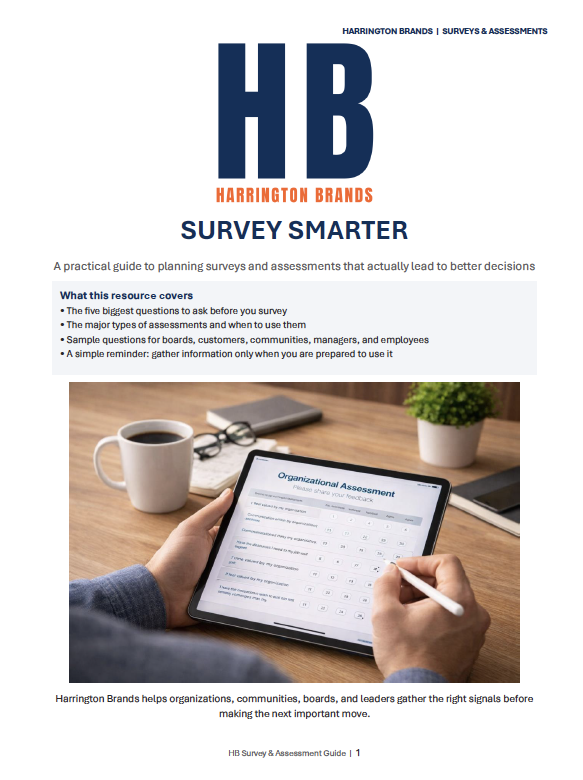
Download our complimentary guide to planning surveys and assessments that actually lead to better decisions
What this resource covers
• The five biggest questions to ask before you survey
• The major types of assessments and when to use them
• Sample questions for boards, customers, communities, managers, and employees
• A simple reminder: gather information only when you are prepared to use it